Days: : 1: Arrive at Tribhuwan International Airport Kathmandu
After arriving in Kathmandu, a representative from Nepal New Generation will pick us up from the airport and take us to our hotel. In the afternoon, we may take a rest or visit Nepal New Generation’s office. In the evening, there will be a welcome dinner hosted by Nepal New Generation. For dinner, you will be served authentic Nepalese cuisine which will introduce you to the country’s food culture. Overnight in Kathmandu. Included meals:Dinne
Days: 2: Obtain Bhutan Visa and Kathmandu Valley Sightseeing Tour
Good morning! Day two is your sightseeing trip to the Kathmandu Valley. Get ready with your breakfast. Our representative will be in a private vehicle outside your Hotel for your day’s visit. The drive from your Hotel is towards Kathmandu Durbar Square. If you stay in Thamel’s Hotel, it will take 10-15 minutes to get to Kathmandu Durbar Square, depending on traffic conditions. Our guide will briefly explain each of the monuments and the historical significance of Kathmandu Durbar Square as you start visiting there. The drive moves towards Swayambhunath from Kathmandu Durbar Square. It is a 10-15 minute drive from Kathmandu Durbar Square to reach Sawambhunath. At Sawambhunath, travelers can appreciate the 360-degree view of Kathmandu Valley and feel the spiritual ambiance of the temple. The drive moves Boudhanath from Swayambhunath temple. It takes 25-30 minutes to get to Boudhanath stupa from Sawambhunath temple. You will find the same atmosphere and practices at Boudhanath as you saw at Sawambhunath, as both are prominent Buddhist religious sites. Visitors can participate in stupa Circumambulation by spinning prayer wheels at Boudhanath and can appreciate the view of the Stupa while having a delicious meal at the rooftop restaurant.
Days: 3 - Fly to Paro. Sightseeing as time permits.
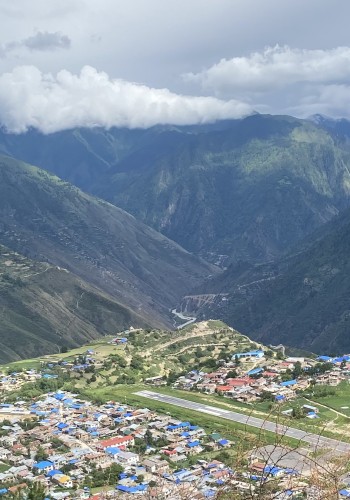
Transfer to the airport for the short flight up to Bhutan. On a clear day the panoramic views of the Himalaya are sensational, including Everest, but particularly exciting is the approach through the Bhutanese foothills and the landing, including a few steep turns on the approach to the tiny airstrip of Paro. If possible try to sit on the left hand side of the plane for the most spectacular views. In Paro you will be met by your Bhutanese guide and taken to your hotel. The Paro Valley has always had a great strategic importance for Bhutan and was historically an important staging post on the trade routes with Tibet. The spectacular Paro Dzong, situated on a rocky outcrop above the Paro Chu and with views down both sides of the valley was historically one of Bhutan's strongest and most strategic fortresses. Before the rebuilding of the Tashidodzong in Thimphu, it was also the seat of Bhutan's National Assembly. Depending on the arrival time of your flight there may be time for some sightseeing in Paro in the afternoon. You might wander around Paro township or pay a quick visit to the huge dzong. Then if there is time and you feel like a walk you could walk back to your hotel.
Days: 4-Paro Valley, Takstang Monastery (3100m) & National Museum
A really exciting and informative day as an introduction to this wonderful country (described in part above). The Paro valley is truly beautiful, being a location for various farming activities, including commercial quantities of asparagus, strawberries and shitake mushrooms for export, plus various grain and vegetable crops. It is a patchwork of colours delineated by well kept traditional design farm houses that are ornately decorated. All of the slopes surrounding the valley are forested and the hint of mountains beyond is alluring. Our morning is spent exploring and appreciating the Tigers Nest Monastery or Taktsang, as it is known in Bhutan, a short drive from our resort. It takes us about 1.5 hours to walk up the winding trail steeply through chir pine forest to a tea house and excellent vantage point. Another 30 minutes or so takes us to the monastery. The monastery is the divine resting place of the Guru Rinpoche, revered as the founder of Tibetan Buddhism. This evening you will need to repack, leaving behind things you will not require on the trek for safe storage with our local partner. Overnight: Hotel Meals: B,L,D
Days: 5- Drive past Drukyel Dzong (2580m) to Shana (2860m) and commence trek to Thongo Zampa (3250m), (11kms, approx 4 hrs)
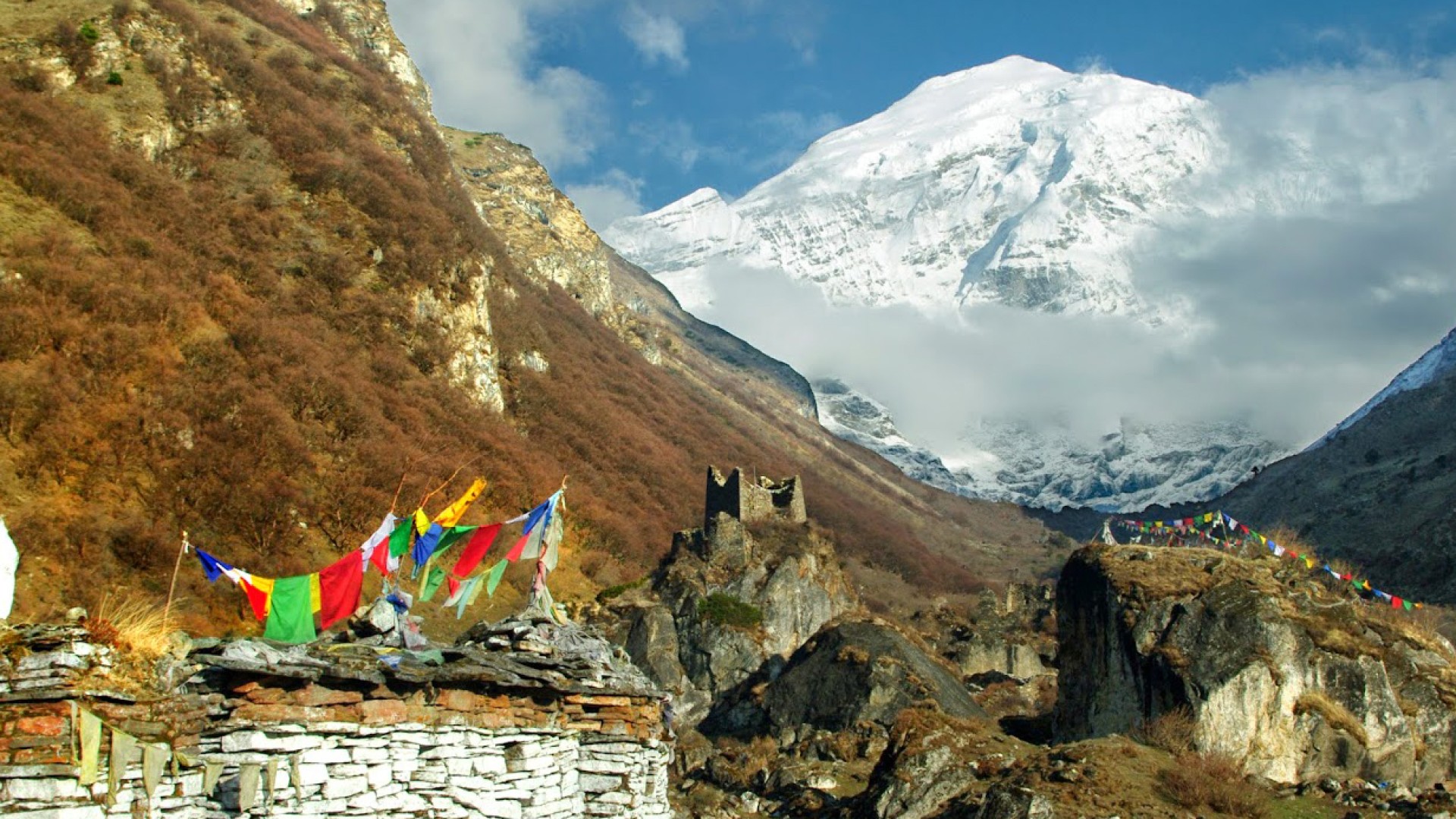
It is a short drive of approx 20 minutes up the Paro valley to Drukyel Dzong, which was originally built as a fortress in 1647 to guard against Tibetans invading the Paro Valley. We continue the drive to Shana (1-1.5h drive) from where our trek commences. On this scenic drive we pass through farm country made up of fields of rice, wheat, barley, mustard, potato, and radish as well as herds of cows. The traditional Bhutanese two storey, timber and stone houses can be seen here. We also gain our first views of the summit of Jomolhari (7314m) at the head of the valley. We get under way and take a break for lunch where it suits us, as we are carrying a packed lunch. Initially the trail is wide and flat, as it meanders steadily through lightly forested fields, which in recent years have been the site of the ongoing large-scale Bhutan Government project to bring electricity to the isolated villages further up the valley. Overnight camp Thongo Zampa. Meals: B,L,D
Days: 6- Trek to Soi Thangthangkha (3700m) (approx 4 hrs)
We now trekking within Jigme Dorje National Park, the largest protected area in the country (4350 sq kms.) which extends beyond Laya to Lunana in the east and all the territory to the south. Whilst it is a protected wilderness, the park management which is based at Gasa, has to cope with the needs of lowland farmers and semi-nomadic yak herders. There is an amazing variety of species of plants and animals in the park at both high and low altitudes. The forests are tall and thick, comprising a variety of oaks, maple, birch, larch pine and allders that will be replaced by more and more rhododendron and pines as we trek higher. There are numerous different varieties of the former, and depending on the onset of warmer temperatures after winter, flowers will be in bloom, or past bloom, as the lower altitudes flower earliest. As we climb higher the rhododendron species change from the common rhododendron arboreum (Nepal's national flower) to griffithianum and cinnabarinum. Many of the camps we stop at are not settlements as might be implied by them having a place name. Most are merely clearings beside a water source, which are also suitable camping sites for seasonal yak herders and workers who are involved in the large scale electrification project that will bring electricity to this region of Bhutan. Meals: B,L,D
Days: 7- Trek to Jomolhari base camp, "Jangothang" 4100m (12kms, approx 5 hours)
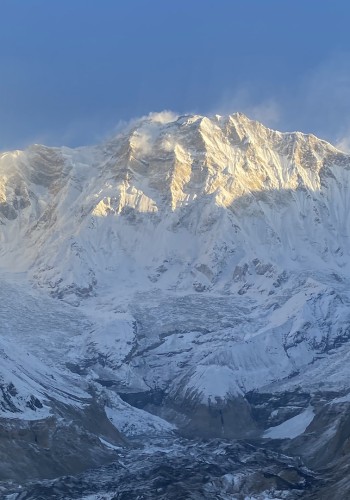
We continue higher to the camp at the base of Jomolhari, a superb alpine setting. Jichu Drake (6794m) rises to our right, with a fine, elegant ridge running down toward the pass that we will cross on our next trekking day. We camp in the vicinity of yak herders from the Paro Valley, who, like their counterparts in Southern Tibet, live in woven yak wool tents throughout the summer months. By now we are above the treeline and the area is characterised by low tundra of juniper and rhododendron setosum, while blue sheep have also been spotted in the higher rocky outcrops. Meals: B,L,D
Days: 8- At Jomolhari base camp, "Jangothang", rest & explore
An important day is set aside for acclimatisation. A side trip up the small valley towards Jomolhari takes us to a dramatic viewpoint towards the glacier and imposing face of this 7000m mountain. Alternatively we may make a scenic excursion up to Sopu lake set adjacent to Nye La pass, both will be worthy photo excursions. As far as mountaineering is concerned, these two peaks, like the rest of Bhutan, have seen little expedition activity from outsiders. Doug Scott successfully climbed Jichu Drake in 1988 on his third attempt, demonstrating that conditions are not so easy on this far east location of the Himalaya being first in line geographically for monsoonal influences. Meals: B,L,D
Days: 9- Cross Nyile La (4850m) (18kms, approx 8 hrs)
From camp we commence our ascent over rolling slopes of grassland and small brush to the Nyile La (4850 metres). This is a relatively long day on the trail, so if this is your first Himalayan pass just take your time, particularly on the final steeper stages just below the pass, where grasses give way to scree and sand. The views enroute to Jichu Drake will inspire you. From the Nyile La we leave Jomolhari and Jichu Drake behind and make a steep descent through dwarf rhododendron shrub towards Lingshi village. In the distance we can soon see the Lingshi Dzong, built to protect this and the other outlying villages of Bhutan from the periodic raids from Tibet. Before we reach the village and the Dzong, we turn off descending to cross a stream, there is a short stiff climb and then a descent into the quiet valley and camp by a stream. Meals: B,L,D
Days: 10- Cross Yale La (4950m) and trek to Shodu (3950m) (Walk approx 8 hrs)
Cross Yale La (4950m) and trek to Shodu (3950m) (Walk approx 8 hrs)
Days: 11- To Barshong (3700m), (Walk approx 7/8hrs)
The path follows the Thimchu River descending through rhododendron, Juniper and pine forests. The view of the cliff facing rocks and water falls are stunning. The trail gradually ascends after 3 to 4 hours to the ruins of Barshong Dzong and our camp for the night. Meals: B,L,D
Days: 12- Complete trek at Dolam Kencho (Walk approx. 5/6hrs). Transfer to Thimphu (approx. 2hrs)
The path descends for a while joining the Thimchu river and gradually ascending and descending through thick bamboo and pine forests. We walk for around 2 hours to reach our old campsite at Domshesha before continuing for another 3-4 hours to Dolam Kencho and the roadhead. Transfer to Thimphu. Pending arrival time, we may visit the Tashichho Dzong, on the time of arrival, we may visit Thimphu Dzong in the afternoon. Any baggage left in Paro on day 2 will be transferred and be available at the hotel in Thimphu. Overnight: Hotel. Meals: B,L,D
Days: 13- In Thimphu, transfer to Paro (approx. 2hrs.)
This morning there is ample time to get a feel for the country's capital or do some shopping in the bazaar. The main Secretariat building, the Tashichho Dzong is the most prominent building consisting of the main Secretariat, the National Assembly Hall, the Office of the King and the Throne Room. Its remarkable construction is in traditional Bhutanese style completed without the use of nails or metal of any kind. There is a large Stupa dedicated to the late King HM. Jigme Dorji Wangchuk, regarded as the founder of modern day Bhutan. Then there is the Handicraft Emporium with famous weaving, woodcarvings and paintings and also the Post Office - Bhutan's exquisite stamps are world-renowned. Overnight: Hotel
Days: 14- Fly to Kathmandu. Transfer to Dwarika's hotel.
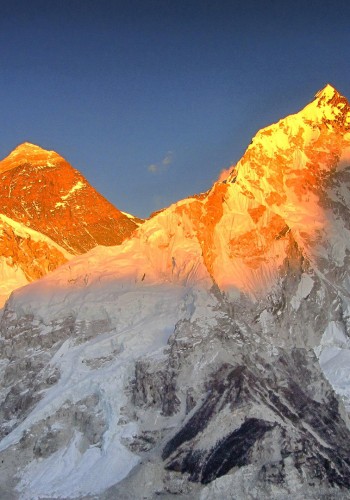
You will be taken to the airport where you will say goodbye to your guide and driver. The flight to Kathmandu is normally an early morning flight which takes you out and over the Bhutanese mountains and past Kangchenjunga, Makalu and Everest, finally dropping down into Kathmandu valley. You will be met and transferred to Dwarika's Hotel, after which there will be plenty of time to relax or for shopping and sightseeing.
Days: 15 - Departure transfer to Kathmandu airport
The airport representative from Nepal New Generation Family will transport you to Kathmandu International Airport around 3 hours before your scheduled flight from where you will depart. Meals: Breakfast included.























 Available